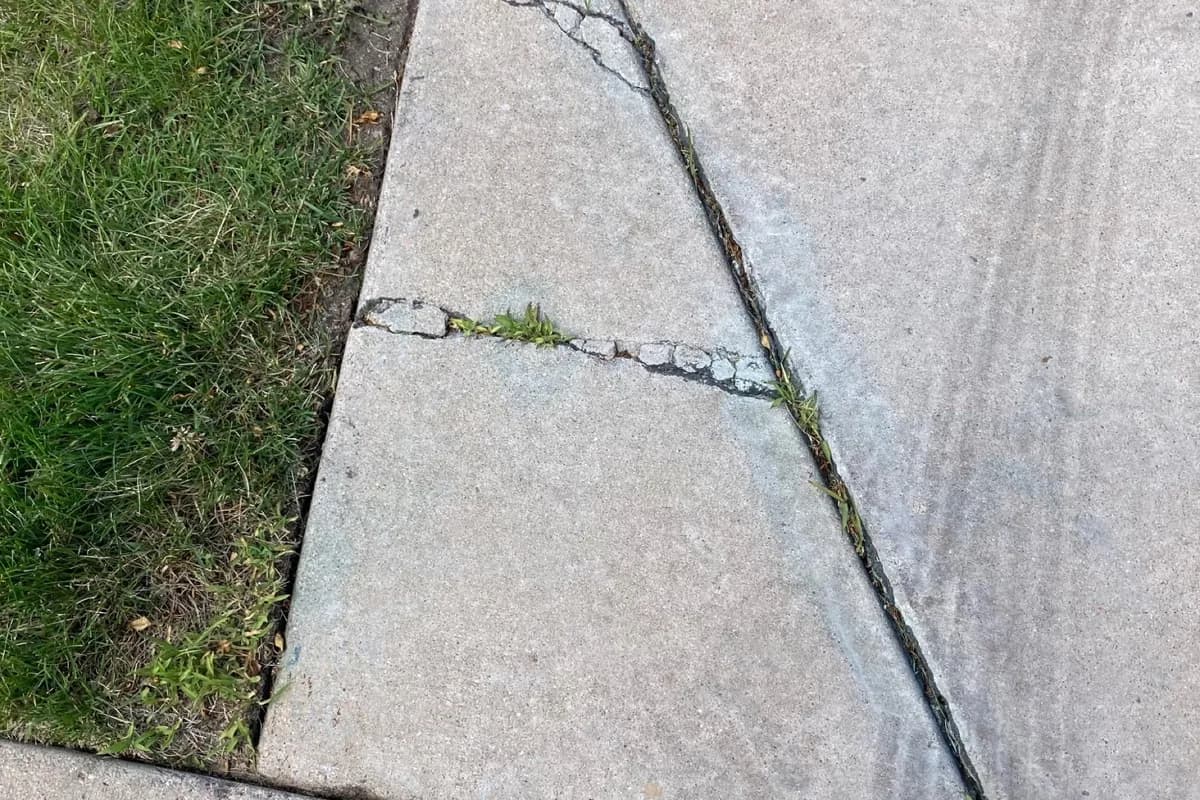
A crack in a driveway or patio looks like a cosmetic problem, but the real damage happens underneath, where you cannot see it. Caulking that crack the right way is one of the cheapest things you can do to protect a slab, but only if it is done with the right material and in the right places.
Why an Open Crack Is Worse Than It Looks
Once a crack opens up, it becomes a direct path for water into the concrete and the soil underneath it. That water freezes and thaws through the winter, widening the crack a little more each cycle, and it can wash fines out of the base material under the slab, creating a void that leads to settling.
A crack that starts as a hairline can, over a few Colorado winters, turn into a crack wide enough to catch a shoe, let weeds root, or contribute to a section of slab settling unevenly. Sealing it early is a lot cheaper than crack and joint repair after it has spread.
This matters most on north-facing or shaded areas of a property, where ice tends to linger longer and the freeze-thaw cycle repeats more often over the course of a single winter.
Soil Washout Under the Slab
Cracks and open joints do not just let water sit on top of the concrete, they let it travel underneath. Once water gets under a driveway or walkway slab, it can slowly carry away the fine particles in the base material, a process called washout. That leaves a gap under the concrete that the slab is no longer fully supported by.
This is one of the more common reasons a slab that looked fine for years suddenly develops a dip or starts rocking when you walk or drive on it. If that has already happened, mudjacking can raise the slab back to grade without full replacement.
Washout tends to show up first at the edges of a driveway near the street, along expansion joints, and directly under downspout discharge points, since those are the spots getting the most concentrated water flow. Catching an open joint before it fully separates is far less invasive than dealing with the settled slab that follows.
Joints Where the Slab Meets the Foundation
The joint where a patio, sidewalk or driveway meets your home's foundation deserves special attention. That is a joint by design, meant to let the two surfaces move independently, but if it is not sealed, it becomes a direct route for water toward your foundation and crawlspace.
This joint should be caulked with a flexible material and checked yearly, since it moves more than a joint in the middle of an open slab and the sealant there wears out faster.
Proper installation matters here as much as the material. A backer rod is typically placed in the joint first to control the depth of the sealant and keep it from bonding to the bottom of the joint, which lets it stretch properly instead of tearing.
Flexible Polyurethane vs. Rigid Fillers
Not all crack fillers are equal. Rigid fillers, like some hardware store crack fillers and rigid mortars, do not flex with the concrete as it expands and contracts with temperature swings. In Colorado's climate, that mismatch often means a rigid filler cracks again within a season or two.
A flexible polyurethane sealant is built to stretch and compress with the concrete through freeze-thaw cycles without losing its bond. It costs more upfront than a tube of hardware store filler, but it stays sealed through the swings our climate puts it through.
Polyurethane sealants also come in self-leveling and non-sag versions. Self-leveling formulas are made for horizontal joints on a driveway or patio, while non-sag versions are formulated to stay in place on a vertical joint, like where a patio meets a foundation wall, without slumping before it cures.
What Caulking Will Not Fix
Caulking is maintenance for existing joints and minor cracks, it is not a structural repair. It will not fix a crack caused by a settling foundation, will not raise a sunken section of slab, and will not stop a crack from reopening if the underlying cause, like soil movement or a drainage problem, is not addressed.
If a crack keeps coming back in the same spot even after it has been sealed, that is usually a sign something underneath needs attention, not that it needs caulk again.
DIY vs. Calling a Pro
Small, hairline cracks in a spot you can easily reach are reasonable to caulk yourself with a quality flexible polyurethane sealant and some patience. Wider cracks, cracks near a foundation, or anywhere you suspect the slab has already started to move, are worth having looked at by someone who repairs concrete for a living, since the material and prep matter more than they look like they would.
Whoever does the work, the crack needs to be clean and dry before sealant goes in. Debris, old caulk residue or trapped moisture in the joint keeps new sealant from bonding properly, which is one of the most common reasons a fresh caulk job fails within months instead of years.
If you would rather have it looked at than guess, call (303) 988-2558 or get a free on-site estimate through our contact page.